
After-school activities for gifted children

Did you know that in Spain only 0.6% of gifted pupils have been officially identified, even though an estimated 2% to 10% actually are? That means that…
Giftedness in children: what it is, the figures, and the keys to understanding it
Did you know that in Spain only 0.6% of gifted pupils have been officially identified, even though an estimated 2% to 10% actually are? That means more than 90% of these children go unnoticed, without receiving the support or the stimulation they need to develop their potential.
In the Spanish education system, a child is considered gifted when they perform far above average in one or more areas. The Ministry of Education classifies these abilities under four headings: giftedness (a high general IQ), simple or complex talents (not defined directly by IQ) and intellectual precocity (a high IQ for their age).
Experts agree, however, that these abilities are not just a matter of IQ. Creativity, motivation, sensitivity and the way they see the world play an essential part in these children’s development. That is why, beyond the labels, it is key to understand their needs and offer them spaces where they can develop their abilities fully.
“Giftedness arises from the interaction between three characteristics: above-averageintellectual ability, high levels oftask commitment and high levels ofcreativity.”
Joseph Renzulli
(A world authority on the study of giftedness and talent education; psychologist and researcher at the University of Connecticut (USA) and director of the National Research Center on the Gifted and Talented.
At what age can it be detected? According to a report by Spain’s Ministry of Education,“early detection can begin fromthree years of age, although formal confirmation is usually carried out during primary education, at around6-7 years, when the profile is more stable.” And experts such as Javier Tourón (Universidad Internacional de La Rioja) and Luz Pérez (UCM) agree that the ideal is to identify it between5 and 8 years, and that the sooner the educational setting is adapted, the better the outlook.
| Age | What can be done |
| 3-4 years | Preliminary early detection (observing behaviour) |
| 5-6 years | Formal assessment with standardised tests |
| 6-8 years | A fuller diagnosis and a proposal for educational adaptation |

What challenges do gifted children face?
The challenges gifted children face can be grouped as follows:
- Emotional and social challenges
A lack of stimulation at school can lead to boredom and demotivation. On top of that comes anasynchrony between their intellectual development — which tends to run well ahead — and their emotional development, which can make intense emotions harder to manage. In childhood they also face the challenge of finding friends with similar interests, which often leads them to withdraw or to “hide” their abilities in order to fit in. - Academic and performance challenges
It is estimated that up to50% of gifted pupils do not reach the level of performance expected for their profile, and around40% may end up failing at school. A failure to adapt the educational setting can leave them with poor study habits and a great deal of demotivation. - Challenges in identification and diagnosis
In some cases giftedness coexists with other difficulties, such as dyslexia or ADHD. That combination can complicate or delay diagnosis and mean both realities go unnoticed: either the difficulties are not detected because high performance masks them, or the giftedness is not recognised because the focus is only on the difficulties.
These challenges make it clear that being gifted is no guarantee of success; it calls forbalanced support combining academic stimulation, emotional support and social understanding.
To support their development, it is key to offer them:
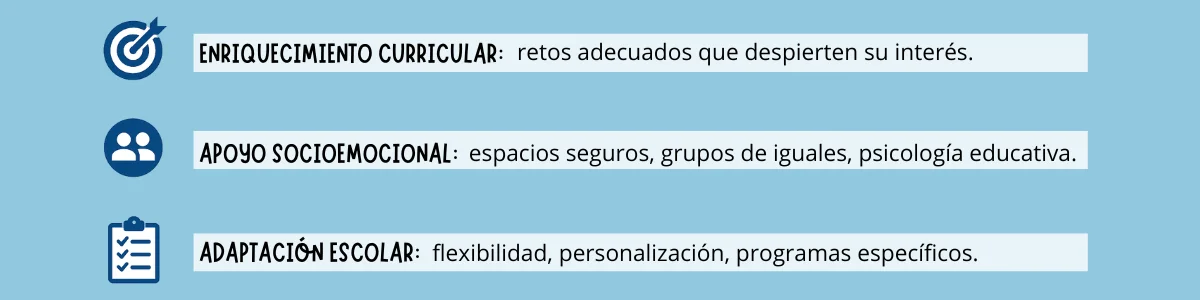
Characteristics of giftedness
Characteristic traits of giftedness:
| Intense curiosity | They seek to go deeper and to debate complex ideas |
| Divergent thinking | They generate creative ideas and unique connections |
| Heightened sensitivity | Great openness to experiences and sensory stimuli |
Special educational needs of gifted children:
| Adapted challenges | Enrichment that pitches the content at their level |
| Individual attention | Personalised approaches that suit their pace and their emotions |
| Emotional support | Attention to their emotional asynchrony and their need for like-minded peers |
What can be done with gifted children outside the classroom?
Recommended after-school activities for gifted children
When a gifted child feels stimulated outside the classroom, their motivation grows. Some examples ofafter-school activities that tend to work very well with these profiles:
a) Technology and science activities
- Artificial intelligence, robotics or creative labs.
- Ideal for experimenting, tackling challenges and creating.
b) Arts and creative workshops
- Music, drama, creative writing, digital illustration.
- They encourage emotional expression and the development of lateral thinking.
c) Public speaking and critical thinking activities
- Debating clubs, philosophy for children, argumentative writing.
These activities let themgo deeper into what they love, mix with other like-minded children and feel understood, something they often do not find in a traditional classroom. (Ministry of Education report on the educational response to intellectually gifted pupils).
d) Physical after-school activities to balance mind and body
Although it is not always mentioned, movement is key to their overall wellbeing. Physical activity helps them:
- Regulate emotions and reduce accumulated mental stress.
- Improve concentration and memory thanks to brain activation.
- Socialise in more natural settings, without the pressure to stand out intellectually.
- Connect with their bodies, stepping away from constant thinking.
Recommended after-school activities:
- Multisport, cooperative games
- Team sports:volleyball,basketball,football
- Arts:street dance,rhythmic gymnastics
(Center for Gifted Education (USA), CDC, SENG)
Stimulate, yes. But without pressure.
Sometimes, on identifying giftedness, people fall into the trap of wanting to “squeeze out” the child’s talent. That is not only counterproductive; itcan create anxiety, low self-esteem and a fear of failure.
What gifted children and teenagers most need is:
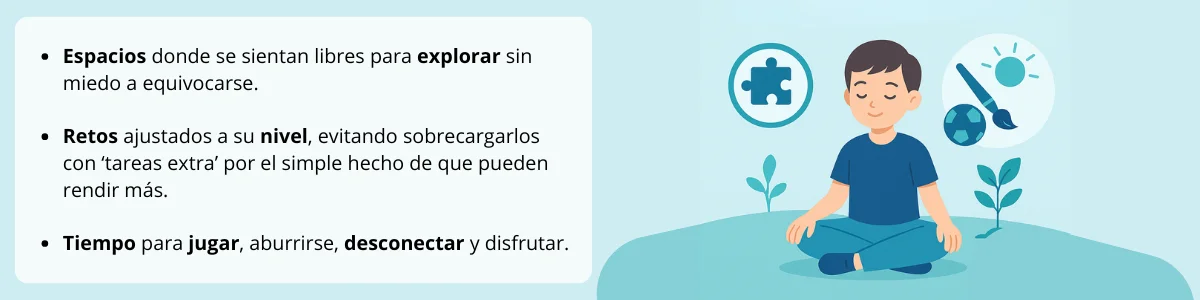
“A gifted child needs to be stimulated, but also protected from outside pressure. Excessive demands can switch off their natural motivation.”
Spanish Association for the Gifted and Talented (AEST).
In summary
| RECOMMENDATION | WHY IT WORKS |
| After-school activities in which to create and investigate | They let them learn at their real pace and connect with other children like them. |
| Project-based workshops | They encourage creativity, critical thinking and intrinsic motivation. |
| Stimulation without pressure | It protects their emotional wellbeing and avoids burnout. |
| Regular physical activity | It balances mind and body, improves focus and reduces stress. |
How do you choose the best activity for each child or teenager?
To choose the most suitable after-school activity, it is important to consider:
- theirreal interests
- theirage
- theircognitive style
Listening to them and offering a range of options is key to them connecting with what they love.Intrinsic motivation — what they do for pleasure, not out of obligation — should be the main compass. If in doubt, consulting a guidance counsellor or educational psychologist can help you understand better how to support a gifted child or teenager and what kind of activity may benefit them most. And always remember:there is nothing like trying things out to discover passions.
The positive long-term impact
When a gifted child or teenager finds a setting in which they feelunderstood andstimulated, the change is profound and lasting:
- the risk of dropping out falls,
- their emotional wellbeing improves and
- their genuine desire to learn flourishes.
They become young people who are moreconnected to theirtalents, moreconfident in themselves and better able to contribute positively to those around them.

And if we are going to support them, let us do it well
Not every gifted child needs the same thing. But they do have one thing in common:they deserve a setting that listens to them, challenges them and lets them be themselves. After-school activities, well chosen, can be that space where they reconnect with their curiosity, their creativity and their motivation to learn.
AtSummit360 we offer activities such asrobotics, artificial intelligence, drama and team sports that can become a real channel for development for many gifted children and teenagers. Our approach always aims tostimulate without pressuring, to support without forcing, and to offer experiences in which growing also means enjoying themselves.
Because in the end that is what it is about: creating spaces where every child can explore what they enjoy, with real learning.